In the golden age of Beautiful Music radio, especially from the 1960s through the 1980s, automation systems played a vital role in delivering the format’s smooth, uninterrupted sound. These systems used large reels of pre-recorded music, commercials, and station IDs, sequenced and timed by mechanical timers or early computers. Beautiful Music stations relied on careful programming to maintain a consistent mood and pacing, often with instrumental arrangements, soft vocals, and gentle transitions. Automation allowed stations to match this flow perfectly, hour after hour, with minimal human intervention.
Technological innovations such as syndicated tapes fundamentally shaped the development and success of the Beautiful Music radio format. Beginning in the 1960s, companies like Schulke Radio Productions and Bonneville Broadcasting used reel-to-reel tapes to distribute pre-recorded, meticulously sequenced blocks of music to affiliated radio stations. This allowed for unprecedented consistency in programming, ensured high fidelity, and drastically reduced staffing needs by enabling automation. Radio stations could broadcast extended, seamless “music sweeps” with few live interventions. Such efficiency and uniformity would have been logistically and economically unfeasible with live announcers or manual playlist management.
Syndicated tapes facilitated rapid expansion of the format nationwide, as stations could instantly access hours of high-quality, professionally curated programming, including smooth transitions and carefully balanced mixes of instrumentals and occasional vocals. The format’s polished, predictable sound became one of its distinguishing features, attracting loyal adult audiences and advertisers seeking reliable demographics.
This technological evolution cemented Beautiful Music’s dominance on FM radio from the late 1960s into the 1980s, establishing a model later adopted by other syndicated radio formats.

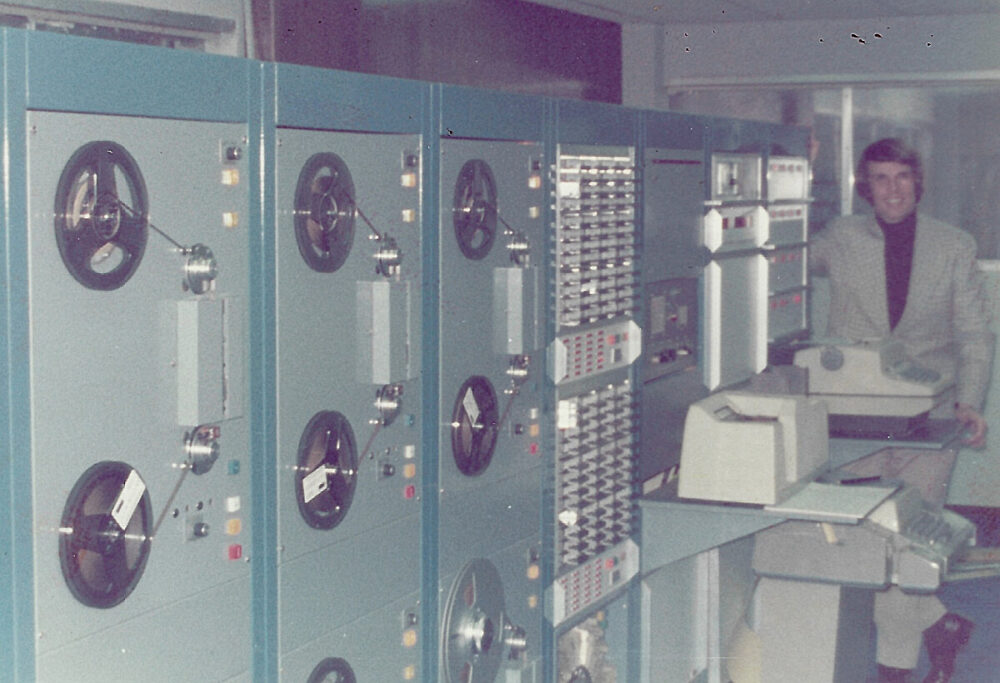
This typical system consisted of three 19" rack cabinets. In the left cabinet was the "system brain." At the top was a clock with pins that could be set to trigger events at different times throughout the hour. The two black rows were thumbwheel switches numbered 0–9, which corresponded to the various playback units. The decks could be programmed to play in a specified order, with the clock resetting the switches every hour, quarter hour, etc.
In the middle of this first rack was the time clock, with even minutes on one tape cartridge and odd minutes on the other. This way, even if one deck was advancing forward by one minute, the other would be ready to play the correct time on the air. Below the time clock decks was a single-play cartridge deck used for station IDs, promos, jingles, weather, etc.
The center rack could be filled with one or more reel-to-reel playback decks. Four decks were used by most syndicators to execute their formats. Pictured are some Ampex 440 units, which were the workhorses of broadcast stations. Below each unit was the stereo playback electronics. Triggering was done by 25 Hz tones on the left channel, which could be quite audible on some high-quality stereo playback systems.
The rack on the right had two twenty-four-slot tape cartridge carousels. Commercials and other announcements were recorded on these continuous-loop cartridges. The brain could be programmed to call up a specific slot at the correct time.
This was the last model made. Before that, there was the very popular 800 series, which first came in a tube version and later the 800T transistor version. Of course, today all of this fits onto a computer hard drive. But back then, the Schafer automation systems made for impressive displays.
There are many great stories of what happened when things got out of sync or the tapes were not loaded correctly.
Check out:


Links to sites on radio automation
Back in this era, the government required operators who had both an AM and FM station to program them separately for at least part of the day. By investing in an automation system, one person could handle the operation of both stations. In many cases, this was an announcer/DJ doing a live show on the AM station while minding the FM station being run by the “robot.”
Here in the 21st century, it’s difficult to imagine broadcast automation without thinking of computers; you can’t have one without the other. But it wasn’t always this way.
Computers and automation systems have both been around for a long time but the two worlds didn’t begin to merge in a big way until the mid-1970s, when IGM introduced the 750 system with a DEC PDP-8.

The FM stations were required to broadcast a certain percentage of their broadcast day separate from their AM stations. So, to do so, with a minimum of cost, stations would use automated systems to broadcast an easy listening format, much different that anything broadcast on their AM stations.

